
Muscle stimulator after surgery: rebuild the muscle at home in Singapore
After an operation the muscle around the joint shrinks fast, because you cannot load it. A muscle stimulator (also called NMES or EMS) makes that muscle contract while normal exercise is still off limits. Use it alongside your physiotherapy, not in place of it.
- Rent a Compex from $150 a month, for 1, 2 or 6 months
- Or buy one from $949, with a 2-year local warranty
- Two rehab programmes built in: Muscle Atrophy and Reinforcement
- Why muscle shrinks
- What NMES does
- The research
- Rehab programmes
- Which model
- Rent or buy
- How to use it
- Questions
Why muscle shrinks after surgery
A muscle keeps its size only while it is being used. After surgery three things work against it at once.
You cannot load it
Weeks in a brace, a cast or on crutches mean the muscle does almost no work. The thigh after knee surgery is the common example: many people see it get visibly thinner within weeks.
It is hard to switch on
Pain and swelling around the joint make it hard to tighten the muscle on purpose. You try to squeeze the thigh and little happens. Your physiotherapist will usually test this at the first visit.
It comes back slowly
Size and strength return with months of steady work. The sooner the muscle starts working again, within what your surgeon allows, the less there is to win back.
What a muscle stimulator (NMES) does
NMES stands for neuromuscular electrical stimulation. Shops often call it EMS. It is the same thing: pads on the skin send small pulses to the nerve that controls the muscle, and the muscle contracts by itself.
That lets you work a muscle before you are allowed, or able, to train it the normal way. Physiotherapists commonly use it after knee surgery, such as an ACL repair or a knee replacement, to get the thigh muscle working again.
NMES or EMS: works the muscle
Strong enough to make the muscle visibly contract. This is the setting used to slow muscle loss and rebuild strength.
TENS: eases the pain
A gentler tingling that gives short-term pain relief. It does not fix the cause. It is best used so that you can then do the exercises your therapist has set. Every Compex has a TENS programme.
What the research says about NMES after surgery
Most of the research is on knee surgery. Across pooled trials, adding NMES to physiotherapy gave people a stronger thigh muscle in the first weeks and months than physiotherapy alone. No study says a stimulator replaces rehab exercise.
After ACL surgery
Review of 11 trials, 2018
Adding NMES to standard physiotherapy improved thigh strength and physical function in the early weeks after surgery, compared with physiotherapy alone. Published in Knee Surgery, Sports Traumatology, Arthroscopy.
After knee replacement
Review of 9 trials, 691 patients, 2021
NMES after surgery improved thigh strength from the first month up to a year, with some gains in pain and walking tests. The authors add that the size of the real-life benefit still needs confirming. An earlier Cochrane review was more cautious.
What this means for you: the studies tested NMES in general, added to physiotherapy, not one brand of device, and mostly on the knee. Results differ from person to person. Use it as part of the programme your physiotherapist sets. This page is not medical advice.
The two Compex rehab programmes
Compex devices in the SP range carry a Rehabilitation category with two programmes, used one after the other.
Step 1: Muscle Atrophy
For a muscle that has shrunk after being rested or immobilised. You can stay relaxed and let the device contract the muscle if you cannot move the joint yet.
Step 2: Reinforcement
The next stage, to rebuild strength once the muscle has some size back.
Alongside: TENS pain programmes
Ease pain around the area between physio sessions, so that you can get on with your exercises.
Which muscle stimulator for rehab at home?
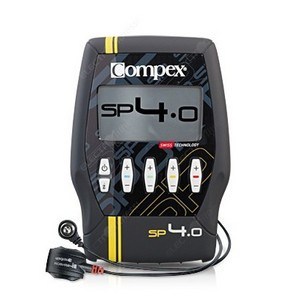
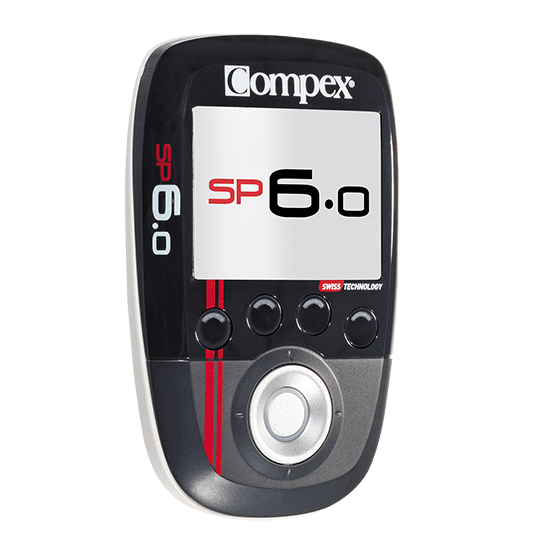
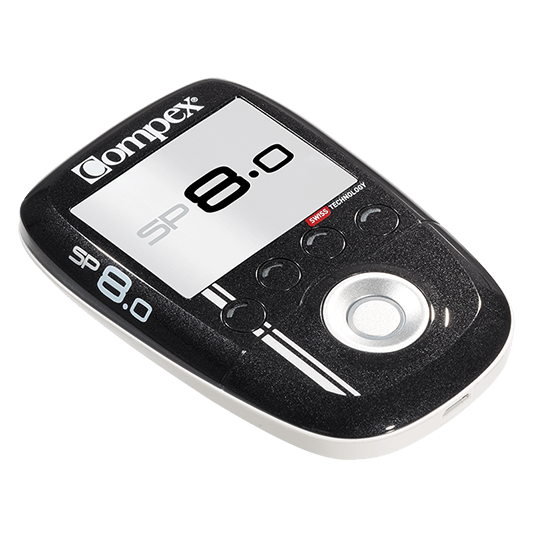
These three Compex models have both rehab programmes. For most people recovering at home, the SP 4.0 is enough.
| Model | Best for | Cables | Buy | Rent | Link |
|---|---|---|---|---|---|
| Compex SP 4.0 | Rehab at home, lowest cost | Wired | $949 | from $150 a month | View |
| Compex SP 6.0 | Rehab at home with no cables | Wireless | $1,399 | Not for rent | View |
| Compex SP 8.0 | Physiotherapists and therapists | Wireless | $1,849 | from $250 a month | View |
The Compex SP 2.0 has no rehab programmes, so we do not recommend it for recovery after surgery. Want the full comparison? See which Compex to buy.
Rent or buy a muscle stimulator in Singapore?
Most rehab after surgery has an end date. If you need the device for a few months, renting costs less. If you will use it for half a year or more, or for training afterwards, buying is better value.
Rent the Compex SP 4.0 (wired)
Refundable deposit $300
- 1 month, 2 packets of pads$170
- 2 months, 2 packets of pads$270
- 6 months, 4 packets of pads$640
Rent the Compex SP 8.0 (wireless)
Refundable deposit $500
- 1 month, 2 packets of pads$270
- 2 months, 2 packets of pads$420
- 6 months, 4 packets of pads$1,040
Prices include the pads. The deposit is paid on top and returned when we get the unit back. We deliver to you free on the same day. At the end you book a delivery back to our warehouse.
How to use a muscle stimulator after surgery
- Get the go-ahead firstAsk your surgeon or physiotherapist when it is safe to start and which muscle to work. Never place pads on a wound or stitches.
- Place the pads on the muscleFor the thigh, the pads go on the front of the thigh, well away from the wound. Your physiotherapist can mark the spots. Our Compex tutorial shows pad placement step by step.
- Start with Muscle AtrophyRaise the level slowly until the muscle clearly contracts. It should feel strong but not painful. If it hurts, lower it.
- Add your own effort when allowedOnce your therapist agrees, tighten the muscle yourself each time the device contracts it. Later, move on to the Reinforcement programme.
- Rest the muscle between sessionsTreat it like the gym. If the muscle is sore the next day, rest it. A good guide is 48 hours before you work the same muscle again.
Do not use a muscle stimulator if you have a pacemaker or other implanted electronic device, or epilepsy. Check with your doctor first if you are pregnant or have a medical condition.
For physiotherapists and rehab clinics
Therapists usually choose the SP 8.0 for its MI-Action function, which combines the patient’s own muscle contraction with the stimulation. It is wireless, so the patient can move freely during a session.
ArmourUP Asia is the official Compex distributor in Singapore. Contact us for medical professional pricing, or send your patients to this page for a rental.
Questions about muscle stimulators after surgery
Can I use a muscle stimulator after surgery?
Many people do, as part of rehab guided by a physiotherapist. A muscle stimulator makes a weakened muscle contract while normal exercise is still limited. Ask your surgeon or physiotherapist when it is safe to start, and never place pads on a wound or stitches.
What is the difference between NMES, EMS and TENS?
NMES and EMS are two names for the same thing: stimulation strong enough to make a muscle contract, used to slow muscle loss and rebuild strength. TENS is a gentler tingling for short-term pain relief. It does not fix the cause of the pain. Every Compex device has both.
Does a muscle stimulator help after knee surgery?
Research supports it as an add-on to physiotherapy. A 2018 review of 11 trials found that adding NMES improved thigh strength and physical function in the early weeks after ACL surgery. A 2021 review of 9 trials found stronger thigh muscles after knee replacement, though the authors said the size of the real-life benefit still needs confirming. It does not replace your rehab exercises.
Which muscle stimulator is best for rehab at home?
We recommend the Compex SP 4.0 for rehab at home. It has both rehab programmes, Muscle Atrophy and Reinforcement, and is the most budget-friendly at $949. Choose the SP 6.0 at $1,399 if you want no cables. Physiotherapists usually choose the SP 8.0.
Can I rent a muscle stimulator in Singapore?
Yes. ArmourUP Asia rents the Compex SP 4.0 from $150 a month and the SP 8.0 from $250 a month, for 1, 2 or 6 months. Pads are included, delivery to you is free on the same day, and a refundable deposit of $300 or $500 is returned when the unit comes back.
Is it cheaper to rent or buy?
Rent if you need it for a few months. Six months of SP 4.0 rental with pads is $640, against $949 to buy. If you expect to use it for longer, or for training after your recovery, buying is better value and comes with a 2-year local warranty.
Which Compex programme should I use after surgery?
Start with Muscle Atrophy, for a muscle that has shrunk after being rested, then move to Reinforcement to rebuild strength. Stay relaxed and let the device contract the muscle if you cannot move the joint yet. Get the go-ahead from your surgeon or physiotherapist first.
How often should I use it during rehab?
Follow your physiotherapist's plan. As a general guide, treat it like the gym: if the muscle is sore the next day, rest it, and leave about 48 hours before you work the same muscle again.
Is a muscle stimulator safe? Who should not use one?
For most healthy adults, yes, when used as the manual says. The muscle can be sore after the first few sessions, and some people get mild skin redness under the pads. Do not use one if you have a pacemaker or other implanted electronic device, or epilepsy, and check with your doctor first if you are pregnant or have a medical condition.
Does it hurt?
It should not. The tingling and the strong contraction feel strange at first. Set the level to strong but not painful. If it hurts, lower it or stop the session.
Not sure if it suits your recovery?
Tell us which operation you had and what your physiotherapist has advised. We will tell you which device fits, or come and try one first.
ArmourUP Asia, 11 Woodlands Close, #08-29, Singapore 737853. By appointment.